

Obesity Drugs: What’s in Store for the UK?

Obesity drugs in the UK

Last reviewed: [January 2026]

Patient Guide

This guide is designed to support patients in understanding their condition and available treatment options, based on current clinical evidence, professional guidelines, and prescribing standards at the time of publication.

Medical knowledge evolves. This content is reviewed and updated periodically, but it may not always reflect the most recent research or regulatory changes. It is intended to complement — not replace — personalised medical advice from a qualified clinician.

How We Got Here: The GLP-1 Revolution

This miniature revolution has been driven by medications known as incretin analogues, or GLP-1 receptor agonists. It began in 2014 with liraglutide (brand name: Saxenda)1 but really took off in 2021 with the release of trial data showing that semaglutide (the famous Ozempic/Wegovy) produced around 14.9% average weight loss over 68 weeks, roughly doubling the efficacy of earlier treatments.2 The latest iteration, tirzepatide (Mounjaro/Zepbound), did better still, with an average 20.9% weight loss in trial patients over the same period.3

These are blockbuster drugs with blockbuster prices. In the UK, the cost of Mounjaro rose from around £189/month to £250–£300/month this summer, as the manufacturer (Eli Lilly) capitalised on extraordinary demand. And there’s more to come: there are at least six major next-generation incretin-based agents in late or mid-stage development.4 Retatrutide has earned the nickname “the Godzilla drug”, showing 24% weight loss at 48 weeks in phase-2 data.5 CagriSema, a combination of semaglutide and cagrilintide, has produced around 20% in phase-3 trials.6

New agents are also being designed to address current weaknesses. The two current leading drugs – semaglutide and tirzepatide – are weekly injections. One focus is on engineering injectables that can be given monthly instead. Also in the pipeline are oral agents, combinations designed to reduce side effects and to preserve muscle mass, which is vulnerable during periods of significant weight loss. Eli Lilly, for example, is testing semaglutide paired with bimagrumab, an antibody known to increase skeletal muscle.

“For a clinical overview of what obesity is and why it is classified as a chronic condition, see our separate guide.”

What Stands Between a Breakthrough Drug and a UK Clinic

For a new obesity drug to become widely available in the UK, three things generally need to happen.

First, it must complete a large phase-3 programme confirming the phase-2 findings and ruling out major safety concerns.7

Second, the MHRA must review the data and grant a licence — a process that typically takes 9–12 months after phase-3 results.8-9 Once this licence is granted, the drug can usually be prescribed privately.

The third step is what determines wide NHS availability: appraisal by NICE, which assesses cost-effectiveness, negotiates pricing arrangements and defines the eligible patient groups.10-11 Even when NICE works in parallel with regulators, this process adds further months12, and the NHS still needs time to organise supply and capacity. Wegovy, for example, was authorised long before it became usable in practice because global demand outstripped supply.13,14,15,16

This means that a drug completing phase-3 trials today might reach private clinics in around a year, and the NHS in two to three years. Faster is possible, but uncommon; slower is common.

When the Process Goes Wrong: A Troubled History of Weight-Loss Drugs

And that assumes that everything goes to plan: the history of weight-loss science is littered with cautionary tales. The earliest effective weight-loss medication was 2,4-dinitrophenol (DNP). Originally an intermediate in the production of explosives, its medical significance became apparent in the 1930s when munitions workers exposed to it began losing weight at an alarming rate.17

DNP worked as a “mitochondrial uncoupler”18 — it disconnected the central metabolic pathways in cells, so that the fuel-burning processes were no longer harnessed to the production of usable energy but instead burned through glucose and oxygen at an unbridled rate. Some unfortunate patients were effectively consumed in the fire of their own rampant metabolism, suffering hyperthermia, dehydration and multi-organ failure. After a number of deaths, the drug was banned in 1938.19

A similar story unfolded in the 1990s with Fenfluramine-Phentermine (“Fen-Phen”). Young patients began presenting with breathlessness and heart murmurs, later found to be signs of scarred heart valves and structural changes in the major blood vessels supplying the lungs (resulting in ‘pulmonary hypertension’), both unintended consequences of activating a subset (‘5-HT₂B’)20 of serotonin receptors. Fen-Phen was withdrawn in 1997.21

The result is that obesity drugs face an even more rigorous licensing process than other drugs: they have to demonstrate both psychiatric and cardiovascular safety before they will be accepted by regulators such as the FDA and MHRA/EMA.

In total, more than a dozen anti-obesity drugs have been withdrawn, restricted, or abandoned due to safety concerns22,23, the most recent of which was danuglipron, a promising oral GLP-1 from Pfizer that might otherwise have reached the market by 2025.24

A Realistic UK Timeline

So any predictions about when we’re likely to see these drugs in the UK are subject to some significant caveats and assumptions, but assuming successful trial results continue and there is a typical regulatory review period, a rough timeline might look like this. The earliest of these drugs could become available in the UK in early 2026, following the FDA approval of high-dose oral semaglutide in December 2025, assuming no unanticipated regulatory or supply impediments.
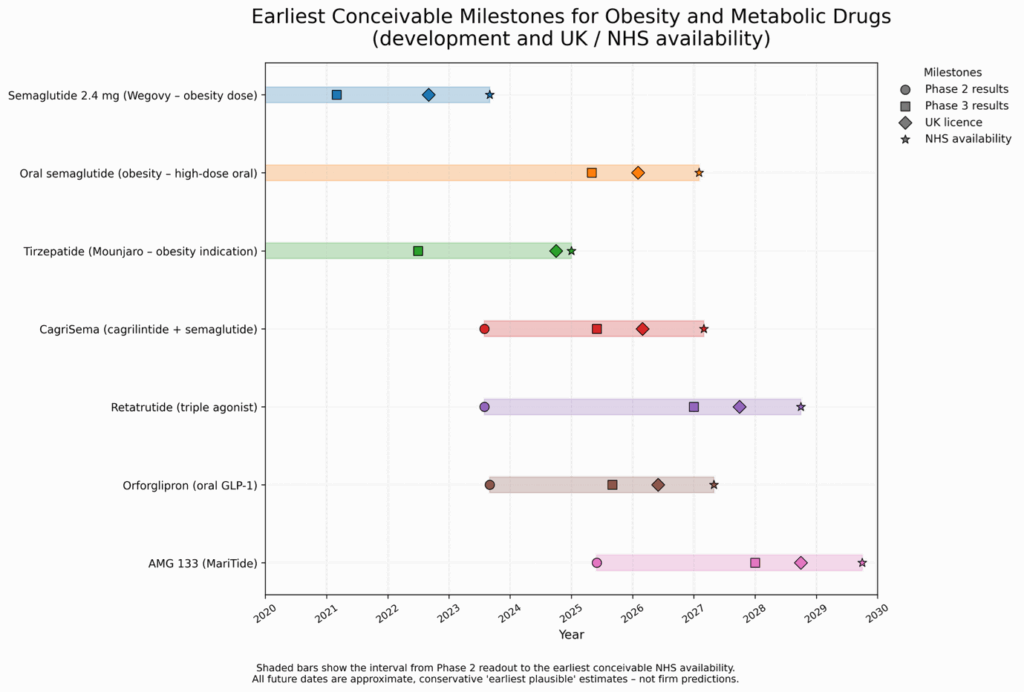

Figure references: 25, 26, 27, 28, 29, 30, 31, 32, 33, 34, 35

The Impact on UK Practise

A jump from 20% average weight loss (tirzepatide, in trial data) to 24% weight loss (with retatrutide, again in trials) will make a difference to some very obese patients.36 That’s very exciting, but potency isn’t what’s missing in the treatments we already have.

The drug which we seem most likely to see next is oral semaglutide (the oral version of Ozempic/Wegovy). A weekly medication might be expected to improve adherence simply because there are fewer opportunities to forget. But injectables bring their own frictions. The availability of an oral option will probably have its biggest impact on uptake – overcoming an obstacle for some patients. But it may improve consistency too: in my own practice, a noticeable minority of patients delay injections, struggle with technique, or occasionally miss a dose.

This matters because, at least early in treatment, the effect of the drugs is strongest in the days after a dose; towards the end of each week, my patients report a return of cravings and appetite – a weakening of the control that these medications rely on for their effect. Weight-loss clinicians have long been familiar with the potential impact of even a short interruption of dietary control: each kilogram of body fat loss is achieved with a hard-fought ~7,700-calorie deficit.37 For people biologically inclined to enjoy food, that deficit is easily whittled away by a few days of normal or uninhibited eating. Even short interruptions in treatment can make all the difference.

In that respect, an oral agent, even with the same side-effect profile, may improve outcomes for some patients. The more significant cause of treatment interruption, however, is the gastrointestinal side effects – nausea, vomiting, diarrhoea, constipation.38 It’s not clear that oral semaglutide will do much to solve this problem. The hope is that agents which rely less on GLP-1 mimicry – like Cagri Sema, and MariTide – may address this concern, but this is yet to be borne out decisively in data.

But the factor with the biggest real-world impact is cost. Again, many of my patients have had periods of interruption to their weight-loss treatment which have been down to cost — they’ve been unable to afford, or bring themselves to spend, the £250+ cost of their monthly Mounjaro. Treatment interruptions are a significant reason for the gap between the astonishing average weight loss achieved in trials and the real-world data.39,40

The steep prices of these agents are also the major reason why they are not in wider use – on the private market, because most people simply can’t afford treatment costing £300 per month, and, on the NHS, where funding is limited by national edict to only the most severe cases.

“We explore the clinical question of whether GLP-1s are suitable as long-term treatments in a separate article.”

A Complex Drug is a Costly Drug

Current injectables require refrigeration.41 If a Mounjaro pen is removed from the fridge, it must be used within 30 days.42 Since a pen needs to last the patient four weeks, any breach of the cold chain from manufacturer to pharmacy makes the pen unsellable. This drives up costs for manufacturers, distributors and suppliers as well as being a headache for patients.

Of great interest from this perspective is orforglipron, a competing agent slightly further back in the pipeline. GLP-1, the molecule in the human body which all the current leading drugs mimic, is a peptide — a chain of amino acids.43 Peptides are large, complex and delicate molecules with correspondingly complex manufacturing processes that scale slowly and at great cost.44 In contrast, orforglipron is a small molecule, made via standard organic synthesis, with simpler manufacturing processes that are less expensive to scale.45,46

Cost is Not Price

In that sense, I’m most excited by anything that will drive down the price. Simpler manufacturing and the absence of a cold chain are helpful (they lower the theoretical price floor) but they are not sufficient. Oral semaglutide is already available for diabetes (branded Rybelsus) and its cost is much the same as the injectable version.47 This is consistent with what’s known about pharmaceutical pricing. What seems to drive prices at the moment is not so much manufacturing or transport costs as intense demand and the desire of the pharmaceutical companies (Eli Lilly, and Novo Nordisk) to recoup their R&D costs and realise their profits while their patents last.48,49,50

So, what I’m most enthusiastic about is competition. In countries like India and China the patents start expiring as early as 2026–2028.51 In the UK, however, patents for semaglutide and tirzepatide run well into the early 2030s. So, for competition, we will need to look to new entrants. But who are the developers of the next four drugs in the pipeline? Novo Nordisk and Eli Lilly.

Important note

Healthcare decisions should always be made in partnership with a qualified healthcare professional, taking into account your individual circumstances, medical history, and current clinical guidance.

If you are using this guide as part of care provided through this service, your clinician will consider the most up-to-date evidence and regulatory guidance at the time of assessment and prescribing.

Frequently Asked Questions

Obesity drugs are medications designed to support weight loss by influencing appetite, fullness, and energy intake. Modern weight-loss injections work by mimicking natural gut hormones involved in regulating hunger and satiety.

These medications help people feel fuller sooner, reduce food cravings, and make it easier to maintain a lower calorie intake over time. For many people, this leads to meaningful and sustained weight loss when combined with lifestyle changes.

They are typically prescribed when excess weight is affecting health and lifestyle measures alone have not been sufficient. Suitability depends on individual medical history and requires ongoing clinical monitoring.

Some obesity drugs were originally developed to treat type 2 diabetes, but they are now also licensed specifically for weight management at different doses or under different brand names.

Medications such as semaglutide act on appetite-regulating pathways in the brain and gut. In people without diabetes, their primary effect is reduced hunger and increased satiety rather than blood sugar control.

Although the underlying medication may be similar, prescribing for obesity follows different criteria and clinical goals. Assessment focuses on weight-related health risks, not diabetes management.

Obesity drugs can be highly effective for long-term weight loss in appropriately selected patients. Many people lose a significant proportion of their body weight over months, particularly when treatment is continued alongside dietary and behavioural support.

Long-term success depends on consistency of treatment, gradual dose adjustment, and realistic expectations. These medications help change appetite biology, which can make sustained weight loss more achievable than lifestyle changes alone.

Results vary between individuals, and treatment plans are usually reviewed regularly to assess benefit, tolerability, and ongoing suitability.

Current evidence suggests that modern obesity drugs are safe for long-term use in most people when prescribed appropriately and monitored regularly. The most common side effects tend to occur early in treatment and often improve with time.

As with any medication, long-term use involves balancing benefits against potential risks. This is why medical assessment, follow-up, and dose adjustments are important parts of treatment.

Not everyone is suitable for these medications, and safety considerations depend on individual medical history, other conditions, and concurrent medications.

The most common side effects of weight-loss injections affect the digestive system. These include nausea, vomiting, diarrhoea, constipation, and abdominal discomfort, particularly when starting treatment or increasing the dose.

Most side effects are mild to moderate and settle as the body adapts. Slower dose increases and dietary adjustments can often reduce symptoms.

More serious side effects are uncommon but require medical advice. Ongoing monitoring helps ensure treatment remains safe and well tolerated.

The NHS does prescribe obesity drugs in specific circumstances, but access is limited and varies by region. Prescribing is usually restricted to people with a high body mass index (BMI) and additional weight-related health conditions.

Treatment is typically offered through specialist weight-management services rather than routine GP prescribing. Waiting times can be long, and not everyone who meets criteria will have immediate access.

Because of these limitations, some people choose to explore private treatment options alongside lifestyle support.

In the UK, obesity drugs obtained privately typically cost from around £100 to £300+ per month, depending on the medication, dose, and level of clinical support included.

Newer injectable medications tend to be at the higher end of this range, particularly as doses are increased over time. Costs may also include consultations, monitoring, and ongoing clinical oversight.

Exact pricing varies between providers and treatment plans. Where available, NHS prescriptions are subject to eligibility criteria and waiting times.

Yes, obesity drugs can be accessed privately in the UK through regulated medical services. Private prescribing typically involves an initial medical assessment, regular follow-up, and clear prescribing criteria.

This route can offer faster access and more flexibility than NHS services. However, it’s important that treatment is provided by appropriately qualified clinicians and includes proper monitoring.

Responsible prescribing focuses on safety, effectiveness, and long-term support rather than medication alone.

When obesity drugs are stopped, appetite often returns toward previous levels, which can make weight regain more likely. This reflects the underlying biology of weight regulation rather than a failure of treatment.

Some people maintain much of their weight loss through ongoing lifestyle changes, while others may regain weight gradually over time. Planning for this possibility is an important part of treatment discussions.

For many, obesity is a long-term condition, and treatment decisions are made with sustainability and long-term health in mind.

Obesity drugs and bariatric surgery are both effective treatments for obesity but differ in effectiveness, risk, and reversibility. Medications offer a non-surgical option and can lead to substantial weight loss without permanent anatomical changes.

Bariatric surgery generally produces greater average weight loss but involves operative risks and lifelong nutritional considerations. It is usually reserved for people with more severe obesity or obesity-related complications.

The most appropriate option depends on individual circumstances, preferences, and medical factors, and is best decided through informed discussion with a clinician.


These answers provide a general overview. For detailed explanations, evidence summaries, and treatment comparisons, see our in-depth guides in the Knowledge Hub.


1 Nordisk N. CENTER FOR DRUG EVALUATION AND RESEARCH Approval Package for: APPLICATION NUMBER: 206321Orig1s000 Saxenda Injection, 3 mg. Liraglutide [rDNA origin] [Internet]. 2014. Available from: https://www.accessdata.fda.gov/drugsatfda_docs/nda/2014/206321Orig1s000Approv.pdf

2 Wilding JPH, Batterham RL, Calanna S. Once-Weekly Semaglutide in Adults with Overweight or Obesity. The New England Journal of Medicine [Internet]. 2021 Feb 10;384(11):989–1002. Available from: https://www.nejm.org/doi/full/10.1056/NEJMoa2032183

3 Jastreboff AM, Aronne LJ, Ahmad NN, Wharton S, Connery L, Alves B, et al. Tirzepatide Once Weekly for the Treatment of Obesity. New England Journal of Medicine [Internet]. 2022 Jun 4;387(3):205–16. Available from: https://www.nejm.org/doi/full/10.1056/NEJMoa2206038

4 Robertson, J. Beyond GLP-1: the next wave of weight-loss medication innovation. The Pharmaceutical
Journal (Feature). 2025 Oct 03. Available at: https://pharmaceutical-journal.com/article/feature/beyond-glp-1-the-next-wave-of-weight-loss-medication-innovation. Accessed 23 Nov. 2025.

5 Jastreboff AM, Kaplan LM, Frias JP, Wu Q, Du Y, Sirel Gurbuz, et al. Triple–Hormone-Receptor Agonist Retatrutide for Obesity — A Phase 2 Trial. The New England Journal Of Medicine [Internet]. 2023 Jun 26;389(6). Available from:https://www.nejm.org/doi/full/10.1056/NEJMoa2301972

6 Garvey WT, Blüher M, Osorto Contreras CK, Davies MJ, Winning Lehmann E, Pietiläinen KH, et al. Coadministered Cagrilintide and Semaglutide in Adults with Overweight or Obesity. New England Journal of Medicine. 2025 Jun 22;393(7).

7 MHRA. Apply for a Licence to Market a Medicine in the UK [Internet]. GOV.UK. 2014. Available from:https://www.gov.uk/guidance/apply-for-a-licence-to-market-a-medicine-in-the-uk

8 MHRA National assessment procedure for medicines [Internet]. GOV.UK. 2025. Available from: https://www.gov.uk/guidance/national-assessment-procedure-for-medicines

9 Jankovic, S. MHRA approvals miss targets by more than 100 days, data show. The Pharmaceutical Journal (News). 2024 Mar 15. Available at: https://pharmaceutical-journal.com/article/news/mhra-approvals-miss-targets-by-more-than-100-days-data-show. Accessed 23 Nov. 2025.

10 Single technology appraisal and highly specialised technologies evaluation: User guide for company evidence submission template | Guidance | NICE [Internet]. Nice.org.uk. NICE; 2015 [cited 2025 Nov 23]. Available from: https://www.nice.org.uk/process/pmg24/chapter/6-the-evaluation-stage

11 About technology appraisal guidance [Internet]. NICE website: The National Institute for Health and Care Excellence. NICE; 2025. Available from: https://www.nice.org.uk/what-nice-does/our-guidance/about-technology-appraisal-guidance

12 Comparing new medicine availability across Europe [Internet]. Abpi.org.uk. 2024. Available from:https://www.abpi.org.uk/media/blogs/2024/june/comparing-new-medicine-availability-across-europe/

13 Roberts M. NHS gets limited stock of Wegovy weight-loss jab. BBC News [Internet]. 2023 Sep 4; Available from: https://www.bbc.co.uk/news/health-66681892

14 Wilding JPH, Batterham RL, Calanna S. Once-Weekly Semaglutide in Adults with Overweight or Obesity. The New England Journal of Medicine [Internet]. 2021 Feb 10;384(11):989–1002. Available from: https://www.nejm.org/doi/full/10.1056/NEJMoa2032183

15 Marketing authorisations granted in September 2021 [Internet]. [cited 2025 Nov 23]. Available from: https://assets.publishing.service.gov.uk/media/6166e4c0e90e07197718297a/Monthly_new_MA_listing_Sept_2021.pdf

16 Accessing Wegovy for weight loss: Everything you need to know – Department of Health and Social Care Media Centre [Internet]. healthmedia.blog.gov.uk. 2023. Available from: https://healthmedia.blog.gov.uk/2023/09/04/accessing-wegovy-for-weight-loss-everything-you-need-to-know

17 Torii S, Goto Y, Ishizawa T, Hoshi H, Goryo K, Yasumoto K, et al. Pro-apoptotic activity of inhibitory PAS domain protein (IPAS), a negative regulator of HIF-1, through binding to pro-survival Bcl-2 family proteins. Cell Death & Differentiation. 2011 May 6;18(11):1711–25.

18 Torii S, Goto Y, Ishizawa T, Hoshi H, Goryo K, Yasumoto K, et al. Pro-apoptotic activity of inhibitory PAS domain protein (IPAS), a negative regulator of HIF-1, through binding to pro-survival Bcl-2 family proteins. Cell Death & Differentiation. 2011 May 6;18(11):1711–25.

19 Grundlingh J, Dargan PI, El-Zanfaly M, Wood DM. 2,4-dinitrophenol (DNP): a weight loss agent with significant acute toxicity and risk of death. Journal of medical toxicology: official journal of the American College of Medical Toxicology [Internet]. 2011 Jul 8;7(3):205–12. Available from: https://www.ncbi.nlm.nih.gov/pubmed/21739343

20 Hutcheson JD, Setola V, Roth BL, Merryman WD. Serotonin receptors and heart valve disease—It was meant 2B. Pharmacology & Therapeutics. 2011 Nov;132(2):146–57.

21 Wadden TA, Berkowitz RI, Silvestry F, Vogt RA, Sutton MGStJ, Stunkard AJ, et al. The Fen-Phen Finale: A Study of Weight Loss and Valvular Heart Disease. Obesity Research. 1998 Jul;6(4):278–84.

22 Ioannides-Demos LL, Piccenna L, McNeil JJ. Pharmacotherapies for obesity: past, current, and future therapies. J Obes. 2011;2011:179674. doi:10.1155/2011/179674

23 Bray GA, Purnell JQ. An Historical Review of Steps and Missteps in the Discovery of Anti-Obesity Drugs. [Updated 2022 Jul 10]. In: Feingold KR, Ahmed SF, Anawalt B, et al., editors. Endotext [Internet]. South Dartmouth (MA): MDText.com, Inc.; 2000-. Available from: https://www.ncbi.nlm.nih.gov/books/NBK581942/

24 Pfizer Provides Update on Oral GLP-1 Receptor Agonist Danuglipron | Pfizer [Internet]. Pfizer.com. 2025. Available from: https://www.pfizer.com/news/press-release/press-release-detail/pfizer-provides-update-oral-glp-1-receptor-agonist

25 Frias JP, Deenadayalan S, Erichsen L, et al. Efficacy and safety of co-administered once-weekly cagrilintide 2.4 mg with once-weekly semaglutide 2.4 mg in type 2 diabetes: a randomised, double-blind, active-controlled, phase 2 trial. Lancet. 2023;402(10403):720-730. doi:10.1016/S0140-6736(23)01163-7.

26 Garvey WT, Blüher M, Osorto Contreras CK, et al. Coadministered cagrilintide and semaglutide in adults with overweight or obesity. N Engl J Med. 2025;393(7):635-647. doi:10.1056/NEJMoa2502081.

27 Jastreboff AM, Ryan DH, Bays HE, et al. Once-monthly maridebart cafraglutide for the treatment of obesity—a phase 2 trial. N Engl J Med. 2025;393(9):843-857. doi:10.1056/NEJMoa2504214.

28 Wharton S, Lingvay I, Bogdański P, et al. Oral semaglutide 25 mg in adults with overweight or obesity. N Engl J Med. 2025;393(11):1077-1087. doi:10.1056/NEJMoa2500969.

29 Wharton S, Blevins T, Connery L, et al. Daily oral GLP-1 receptor agonist orforglipron for adults with obesity. N Engl J Med. 2023;389(10):877-888. doi:10.1056/NEJMoa2302392.

30 Wharton S, Aronne LJ, Stefanski A, et al. Orforglipron, an oral small-molecule GLP-1 receptor agonist for obesity treatment. N Engl J Med. 2025. doi:10.1056/NEJMoa2511774.

31 Jastreboff AM, Kaplan LM, Frías JP, et al. Triple–hormone-receptor agonist retatrutide for obesity—a phase 2 trial. N Engl J Med. 2023;389(6):514-526. doi:10.1056/NEJMoa2301972.

32 Jastreboff AM, Ryan DH, Bays HE, et al. Once-monthly maridebart cafraglutide for the treatment of obesity—a phase 2 trial. N Engl J Med. 2025;393(9):843-857. doi:10.1056/NEJMoa2504214.

33 Davies M, Pieber TR, Hartoft-Nielsen ML, Hansen OKH, Jabbour S, Rosenstock J. Effect of oral semaglutide compared with placebo and subcutaneous semaglutide on glycemic control in patients with type 2 diabetes: a randomized clinical trial. JAMA. 2017;318(15):1460-1470. doi:10.1001/jama.2017.14752.

34 Medicines and Healthcare products Regulatory Agency (MHRA). MHRA authorises Mounjaro (tirzepatide) for weight management and weight loss. Gov.uk. 2023. Available from: https://www.gov.uk/government/news/mhra-authorises-diabetes-drug-mounjaro-tirzepatide-for-weight-management-and-weight-loss

35 Novo Nordisk. Wegovy (semaglutide 2.4 mg) summary of product characteristics. Medicines.org.uk. 10 May 2022. Available from: https://www.medicines.org.uk/emc/product/13799/smpc

36 Farzam K, Patel P. Tirzepatide [Internet]. PubMed. Treasure Island (FL): StatPearls Publishing; 2024. Available from: https://www.ncbi.nlm.nih.gov/books/NBK585056/

37 Thomas DM, Gonzalez MC, Pereira AZ, Redman LM, Heymsfield SB. Time to Correctly Predict the Amount of Weight Loss with Dieting. Journal of the Academy of Nutrition and Dietetics [Internet]. 2014 Jun;114(6):857–61. Available from: https://www.ncbi.nlm.nih.gov/pmc/articles/PMC4035446/

38 Powell WC, Song X, Mohamed Y, Walsh D, Parks EJ, McMahon TM, et al. Medications and conditions associated with weight loss in patients prescribed semaglutide based on real‐world data. Obesity. 2023 Aug 18;31(10):2482–92.

39 Abdel‐Bary M, Brody A, Schmitt J, Prieto K, Wetzel A, Juo Y. Treating class 2–3 obesity with glucagon‐like peptide‐1 agonists: A 2‐year real‐world cohort study. Diabetes, Obesity and Metabolism. 2025 Mar 19.

40 Medhati P, Shin TH, Wasden K, Mathur V, Apovian C, Nimeri A, et al. GLP-1RA in the Real World: 1-year Compliance and Outcomes of Semaglutide use in Patients With or Without Previous History of Bariatric Surgery. Annals of surgery [Internet]. 2025 Jun;10.1097/ SLA.0000000000006748. Available from: https://pubmed.ncbi.nlm.nih.gov/40334053/

41 EMC. Phenoxymethylpenicillin 250 mg Tablets – Summary of Product Characteristics (SmPC) – (emc) [Internet]. Medicines.org.uk. 2024. Available from: https://www.medicines.org.uk/emc/product/15480/smpc

42 How should the Mounjaro® (tirzepatide) KwikPen® be stored? [Internet]. Lilly.com. 2025. Available from: https://medical.lilly.com/uk/products/answers/how-should-the-mounjaro-tirzepatide-kwikpen-be-stored-217607

43 Wang L, Wang N, Zhang W, Cheng X, Yan Z, Shao G, et al. Therapeutic peptides: current applications and future directions. Signal Transduction and Targeted Therapy [Internet]. 2022 Feb 14;7(1):48. Available from: https://www.nature.com/articles/s41392-022-00904-4

44 Otvos L, Wade JD. Big peptide drugs in a small molecule world. Frontiers in Chemistry [Internet]. 2023 Dec 7;11. Available from: https://www.ncbi.nlm.nih.gov/pmc/articles/PMC10740154/#B41

45 Wharton S, Aronne LJ, Stefanski A, Alfaris NF, Ciudin A, Yokote K, et al. Orforglipron, an Oral Small-Molecule GLP-1 Receptor Agonist for Obesity Treatment. New England Journal of Medicine. 2025 Sep 16.

46 Wang L, Wang N, Zhang W, Cheng X, Yan Z, Shao G, et al. Therapeutic peptides: current applications and future directions. Signal Transduction and Targeted Therapy [Internet]. 2022 Feb 14;7(1):48. Available from: https://www.nature.com/articles/s41392-022-00904-4

47 Buy Ozempic Weight Loss Injection | FAST Delivery [Internet]. Click2Pharmacy. 2025 [cited 2025 Nov 24]. Available from: https://click2pharmacy.co.uk/product/rybelsus-semaglutide/

48 Angelis A, Polyakov R, Wouters O J, Torreele E, McKee M. High drug prices are not justified by industry’s spending on research and development. BMJ 2023; 380:e071710 doi:10.1136/bmj-2022-071710

49 Torreele E, McKee M. The UK must defend drug price controls. BMJ [Internet]. 2025 Oct 20 [cited 2025 Oct 22];391:r2201. Available from: https://www.bmj.com/content/391/bmj.r2201

50 Tavasoli Hozouri N, Conrad R, Glos L, Nance S, Tillman Z, Davis K; U.S. Food & Drug Administration, Center for Drug Evaluation and Research. Estimating Cost Savings from New Generic Drug Approvals in 2023. Silver Spring (MD): FDA; November 2025. Available from: https://www.fda.gov/media/189635/download?attachment

51 Science and Technology Law Review [Internet]. Columbia.edu. 2024. Available from: https://journals.library.columbia.edu/index.php/stlr/blog/view/653


About the Author

Dr Joey Blunt MBChB (Hons), MA (Cantab), MRCGP, GPwER (Lifestyle Medicine)

Dr Blunt is a UK-licensed General Practitioner with an Extended Role in Lifestyle Medicine, and a specialist interest in metabolic health, obesity management, and evidence-based medicine. He has completed accredited training in medical weight management, including the national SCOPE obesity programme.

His writing focuses on translating high-quality research into clear, practical explanations to help readers understand complex topics in obesity, medication safety, and long-term health.

GMC: 7527933

Medical Disclaimer

This information is for educational purposes only and should not be considered medical advice. Always consult with a qualified healthcare professional for diagnosis and treatment of any medical condition. All content on this website is for general information only and does not replace personalised medical advice. See full Medical Disclaimer.